
The Honey Hunters of the Sundarbans
The Honey Hunters of the Sundarbans
Into the Wild: The Honey Hunters of the Sundarbans
Following the Tides, Traditions and Struggles Behind the Sundarbans Honey Hunt
Project: Honey Hunting Expedition & Documentary Production
Location: Kalabogi & the Sundarbans, Bangladesh
Expedition Duration: Part of a 13-day field project
Honey Hunting Filming: 3 Days
Production: International Documentary / Film Project
Field & Production Support: Iconic Ecotourism
Project Overview
Deep inside the Sundarbans, honey hunting is more than an occupation. For the Mouals—the traditional honey collectors of the Sundarbans—it is a seasonal livelihood shaped by tides, forests, rivers, weather, tradition and the constant uncertainty of working inside one of the world's most challenging natural environments.
As part of a wider 13-day field and documentary project in Kalabogi, an international film crew travelled into the Sundarbans to document the lives and livelihoods of the people who depend on the forest. A dedicated three-day expedition followed the honey hunters from their homes and preparations to their journey into the forest and the traditional process of collecting wild honey.
The project was developed for an international documentary production involving Kraken Films, France, and CNA Insider, with international media professionals joining the field production. Kraken Films describes itself as a French audiovisual company producing documentaries and reports for French and international media, including work with CNA and Al Jazeera.
Before the Forest: Preparing for the Honey Hunt
The story of a honey hunt begins long before the collectors enter the forest. The filming documented the preparations at the community level—the preparation of the household, equipment and boat, the gathering of the honey-hunting team and the early-morning departure toward the Sundarbans.
These preparations offered the film crew an intimate look at the people behind the profession and the livelihood decisions that take them into the forest each season.
Entering the Sundarbans: Tradition, Ritual & Respect
After travelling through the waterways, the honey hunters enter the forest with a deep awareness of the risks and uncertainties ahead. Before beginning their search, they observe traditional practices associated with Bonbibi, reflecting the cultural relationship between forest-dependent communities and the Sundarbans.
The documentary captured this transition-from community life to the forest, from preparation to ritual, and finally to the beginning of the honey hunt.
Following the Honey Hunters Into the Forest
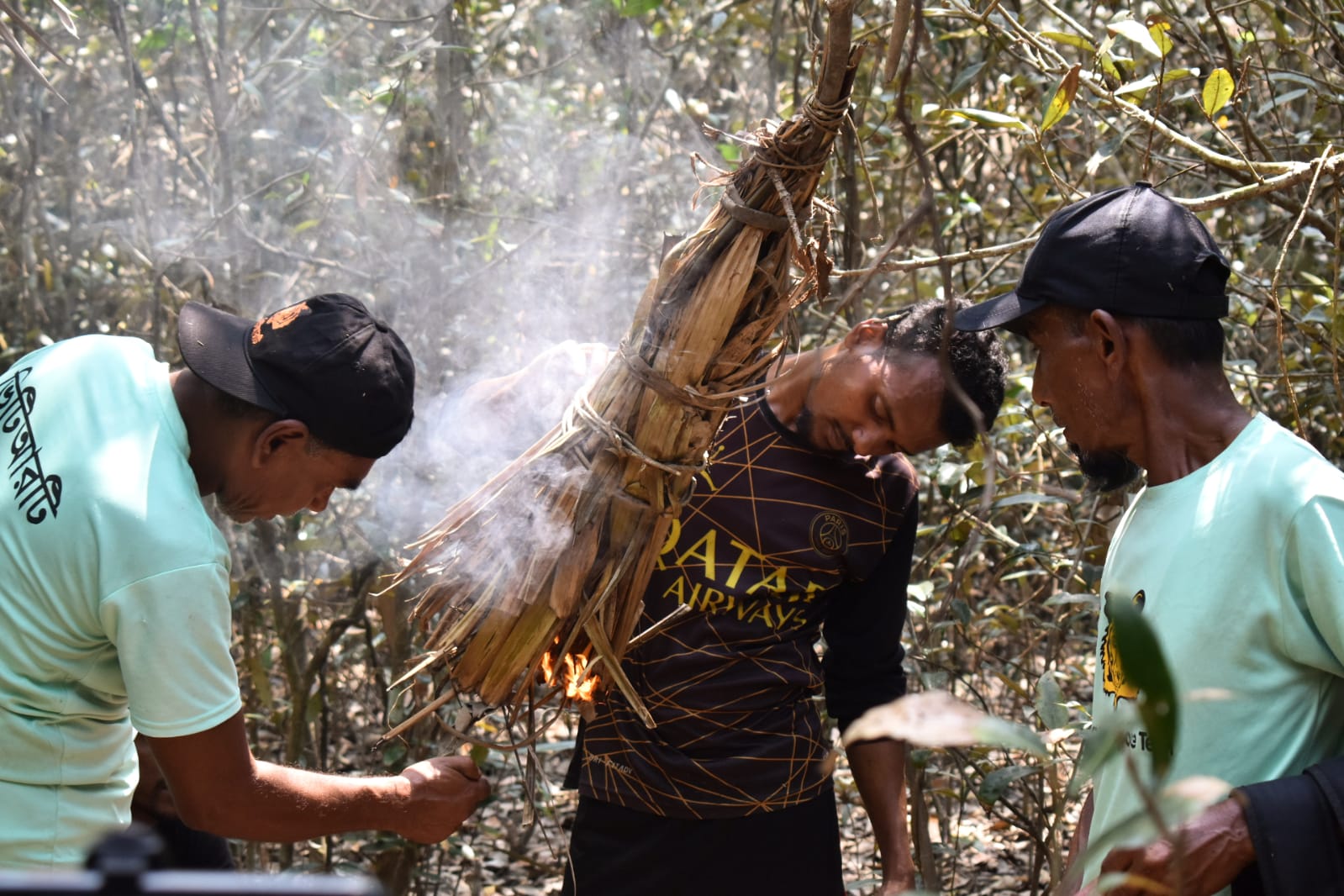
Once inside the forest, the collectors spread out in search of flowering mangrove trees where wild bees have established colonies.The filming followed the process from searching and locating a hive to signalling the rest of the team and gathering together at the location. The expedition documented the knowledge, teamwork and physical effort required to collect wild honey in the mangrove environment.
The Honey Hunt: Skill, Risk & Livelihood
Wild honey collection in the Sundarbans demands experience, coordination and an intimate understanding of the forest. The collectors work in an environment where changing tides, dense mangroves, wildlife and unpredictable conditions can make every expedition challenging. Yet for these communities, honey collection is part of a broader livelihood system that may also include fishing, crab collection, collecting naturally drifted wood and catching small fish and fry. The documentary sought to show not only the act of collecting honey, but the human story behind the livelihood.
Living With the Tides
One of the central themes of the documentary was the relationship between tides and livelihood. For communities living beside the Sundarbans, the tide is not simply a natural phenomenon. It influences when they can travel through the waterways, where they can enter the forest, how they move their boats and how they plan their daily activities.
Through interviews and field observations, the production explored how honey collectors understand and adapt to the changing tidal conditions of the Sundarbans.
A Community Shaped by the Sundarbans
The honey hunters are part of a much larger story of forest-dependent communities. In areas such as Kalabogi and Fakir Kona, families have developed multiple livelihood strategies around the surrounding rivers, tidal waterways and Sundarbans. Fishing, crab collection, honey gathering, collecting naturally drifted wood and other seasonal activities all contribute to household survival.
The documentary therefore placed honey hunting within a wider story: how people adapt their lives to a landscape shaped by water, tides, forests and environmental uncertainty.
International Documentary Production & Field Storytelling
The expedition brought together an international production team with experience in documentary filmmaking and journalism. A French videographer and an international journalist travelled to Bangladesh to document the honey hunters and the communities connected to the Sundarbans. Interviews, field observations and cinematic footage were captured throughout the expedition.
The project formed part of a wider international documentary production involving Kraken Films and CNA Insider. CNA Insider is the documentary/storytelling arm of Singapore-based CNA, while Kraken Films' own profile identifies CNA among its international media partners.
Iconic Ecotourism: From Local Access to International Production Support
Iconic Ecotourism played a central role throughout the production—not simply as a local logistics provider, but as the on-ground production and field-support partner connecting the international team with the Sundarbans and its communities
.
Our responsibilities included accommodation, food, transportation, vessel and field logistics, local navigation, community coordination, professional local guidance, interview arrangements and equipment movement. Iconic's field team remained involved throughout the expedition, helping the production crew reach remote locations and work safely and efficiently within the complex tidal environment.
Beyond logistics, Iconic Ecotourism also contributed as a local producer, interpreter and translator, supporting interviews between international filmmakers and local communities. Our team assisted with translation and interpretation, helped structure and understand field interviews, supported the production workflow, and contributed to post-production and subtitle preparation/editing so that the stories and voices captured in the Sundarbans could be communicated to an international audience.
From Field Footage to an International Story
The project did not end when the cameras left the Sundarbans. Iconic Ecotourism continued to support the production through the subsequent stages of the project, including translation, interview interpretation, subtitle support and post-production assistance.
This made the project a complete example of how local expertise can become part of an international documentary workflow-from field access and production logistics to translation and post-production support.
Our Contribution
Local Production Partner | Field Logistics | Local Guide | Interpreter | Translator | Producer | Post-Production Support | Subtitle Support
Project Impact
The project created an opportunity to bring an often-overlooked story from the remote communities of the Sundarbans to an international audience.
By documenting the honey hunters, their traditional practices, livelihood challenges and relationship with the tides and forest, the production helped present the Sundarbans not only as a wildlife destination, but also as a living landscape shaped by people, culture, water and nature.
Collaborate With Iconic Ecotourism
Planning a Documentary, Research Expedition or Field Production in the Sundarbans? Iconic Ecotourism welcomes documentary filmmakers, journalists, researchers, production companies, photographers and international media teams looking to explore and document the Sundarbans.
With extensive local field experience, we can support projects beyond conventional tourism logistics. From local production management, vessel and transportation arrangements, accommodation and catering to field navigation, community access, local guiding, translation, interpretation, interview coordination, equipment logistics, production assistance and post-production support, our team can work as your local production partner on the ground.
If your next project requires authentic access, reliable local coordination and people who understand the Sundarbans from the inside, get in touch with Iconic Ecotourism to discuss your project and build a tailored field-production plan with us.